Walking onto a gym floor with rows of unfamiliar machines is confusing. Each one has a seat, a pin, a handle and a diagram, and most are easy to use once you know what they do. This guide covers the machines you are most likely to meet, what muscles they work, and how to set them up.
How to approach any machine
Before you load a weight, follow the same 4 steps.
- Read the diagram. Most machines have a picture of the muscles worked and the starting position.
- Adjust the seat. Set the seat height so the joint being worked lines up with the machine's pivot point, usually marked with a dot or a hinge.
- Choose a light weight. Move the pin to a low weight and do a few easy reps.
- Move slowly and fully. Control the weight up and down, and do not let the stack slam.
If you cannot work out the adjustment, ask a trainer. 2 minutes of setup prevents a lot of awkward sessions.
Lower body machines
Leg press
You sit or recline and push a platform away with your feet. It works the quadriceps (front thigh), glutes and hamstrings. It is a good alternative to the squat for beginners because your back is supported.
- Place your feet about shoulder width apart on the platform.
- Lower until your knees are bent to about 90 degrees, without your lower back lifting off the seat.
- Do not lock your knees fully at the top.
Leg extension
You sit and straighten your knees against a pad. It isolates the quadriceps. Use light to moderate weight and avoid slamming at the top.
Leg curl (seated or lying)
You bend your knees against a pad to work the hamstrings at the back of your thigh. Control the lowering phase.
Hip abduction and adduction
The seated machine that moves your legs apart works the outer hips and glutes (abduction), and bringing legs together works the inner thighs (adduction). These are useful accessory machines, not the main event.
Calf raise
Standing or seated, you push up onto your toes. It works the calf muscles, which help with walking, running and balance.
Upper body machines
Chest press
You sit and push handles forward. It works the chest, front shoulders and triceps. It is a stable alternative to the bench press.
Shoulder press
You push handles overhead. It works the shoulders and triceps. Keep your back against the pad and do not arch.
Lat pulldown
You sit and pull a bar down toward your upper chest. It works the lats (the large muscles of your back), biceps and upper back. It is a great stepping stone toward pull-ups. Pull the bar to your chest, not behind your neck.
Seated cable row
You sit with feet braced and pull a handle toward your stomach. It works the mid back, rear shoulders and biceps. Keep your chest tall and do not rock excessively.
Pec deck (chest fly)
Arms swing together in front of you. It trains the chest, with some shoulder work. Keep the weight moderate to protect the shoulders.
Bicep curl and triceps machines
These isolate the front and back of the upper arm. They are optional extras for beginners.
Cables and multi-station machines
The cable machine has a pulley with an adjustable handle. It can train almost any muscle, with exercises like triceps pushdowns, face pulls, cable rows and woodchops. The Smith machine holds a barbell on fixed rails, useful for learning squats and presses, though the fixed path can feel unnatural for some bodies.
Core machines
- Ab crunch machine: works the abdominal muscles.
- Back extension bench: works the lower back and glutes. Move slowly and do not overarch.
- Assisted pull-up machine: a platform or counterweight reduces your bodyweight so you can practise pull-ups and dips.
Cardio machines
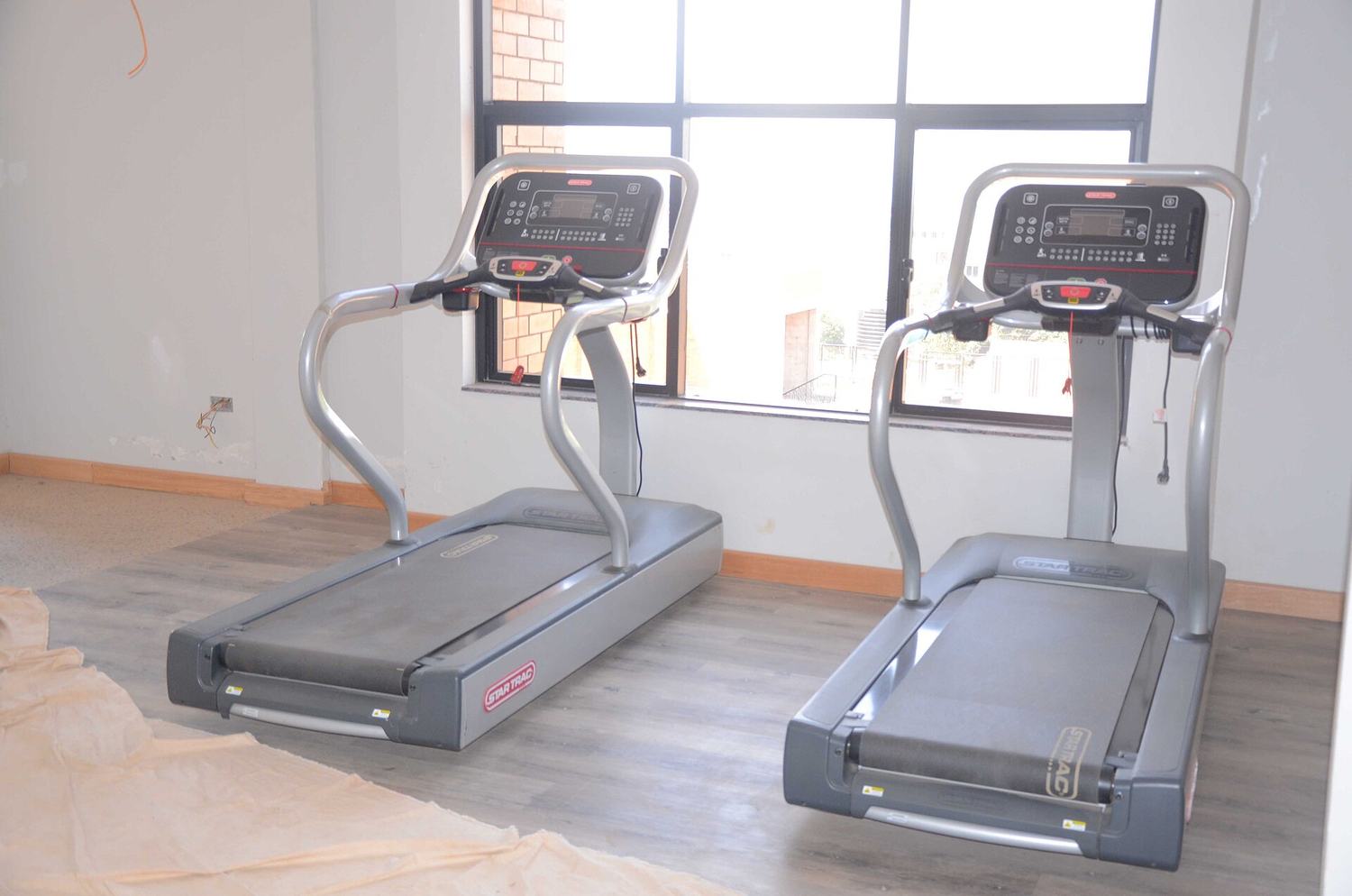
- Treadmill: walking, jogging or running. Start with a brisk walk and add incline. Hold the rails lightly rather than leaning on them.
- Stationary bike: low impact and easy on the joints. Adjust the seat so your knee is slightly bent at the bottom of the pedal stroke.
- Elliptical trainer: low impact, works legs and arms together.
- Rowing machine: a full-body machine that works legs, back and arms. Drive with the legs initially, then lean back, then pull with the arms. Technique matters, so ask for a demonstration.
- Stair climber: works the glutes and thighs hard. Do not lean heavily on the handrails.
For general fitness, 20 to 30 minutes at an effort where you can talk but not sing is a solid session.
A simple machine circuit for newcomers
Do this 2 times a week, with a day of rest between. Choose a weight that lets you finish each set with 2 or 3 reps left.
- Leg press: 2 sets of 10 to 12
- Chest press: 2 sets of 10 to 12
- Lat pulldown: 2 sets of 10 to 12
- Shoulder press: 2 sets of 10
- Seated leg curl: 2 sets of 10 to 12
- Seated cable row: 2 sets of 10 to 12
- Ab crunch machine or plank: 2 sets
- Treadmill or bike: 10 minutes easy
Rest about 1 to 2 minutes between sets. After 3 or 4 weeks, add a set or a little weight.
Common mistakes
- Setting the seat incorrectly. This is the number 1 reason machines feel awkward or uncomfortable.
- Using too much weight. If you swing, jerk or hold your breath, go lighter.
- Rushing reps. Slow and controlled is more effective and safer.
- Using only machines you like. Cover legs, push, pull and core across the week.
- Ignoring pain. A muscle burn is normal; sharp pain in a joint is not. Stop and ask a trainer or physiotherapist if it persists.
Key takeaways
- Read the diagram, set the seat, then start light on every new machine.
- Leg press, chest press, lat pulldown and cable row cover most of the body.
- Cable machines are versatile; cardio machines vary in impact and demand.
- A simple full-body machine circuit 2 times a week is a solid start.
- Control the weight and avoid locking joints or rushing reps.
- Ask a trainer for help whenever you are unsure of a setup.