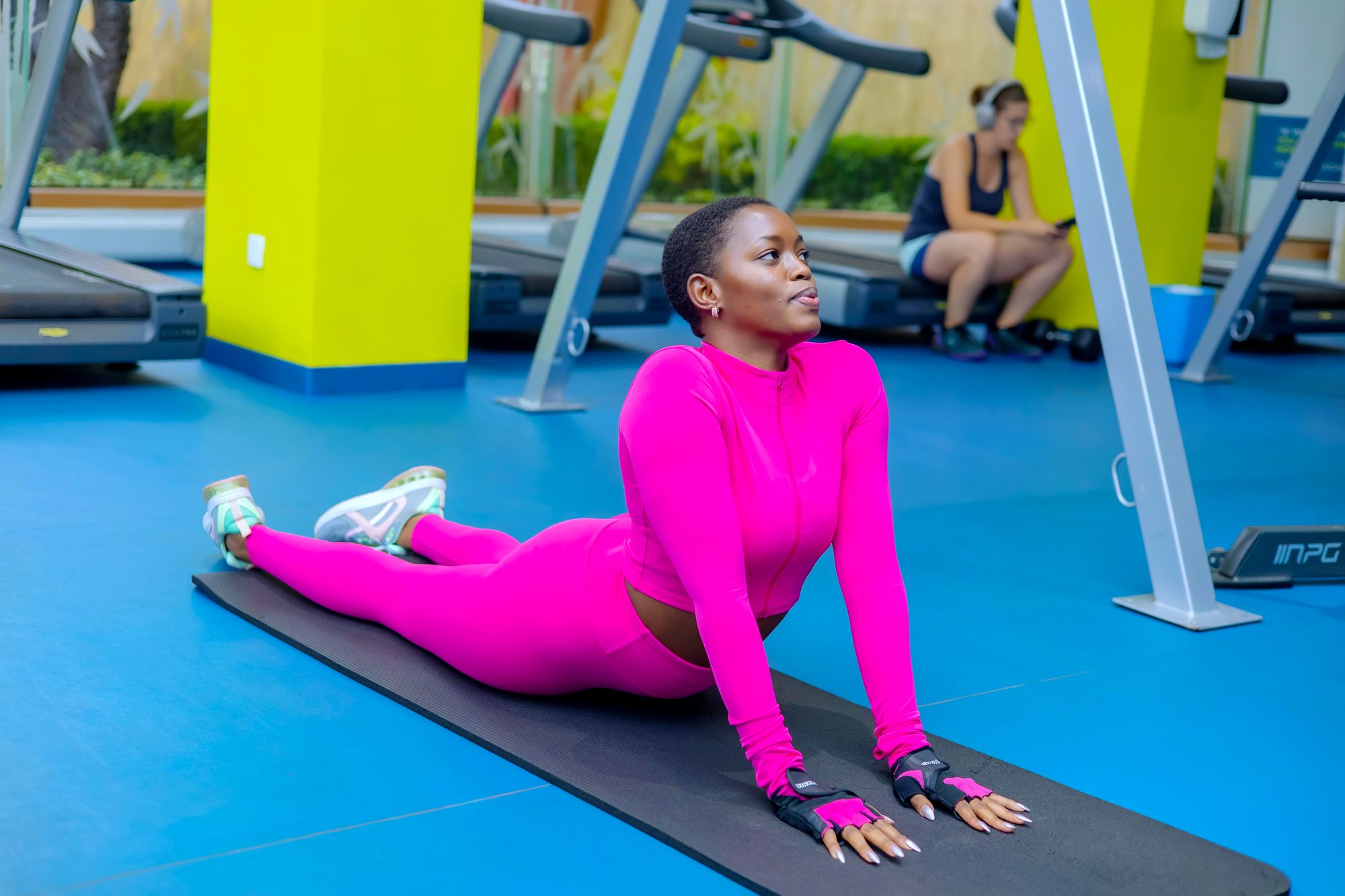
If you spend your day at a desk, in a car, or in Kampala traffic, your hips spend most of their time bent at about 90 degrees. Do that for years and the muscles at the front of the hip get short and sleepy, while the glutes at the back switch off. The result is a stiff feeling when you stand up, a tight lower back, and squats that feel stuck.
The good news is that hips respond quickly to regular, gentle work. You do not need an hour. You need about 12 minutes, done most days.
Why desk hips get stiff
The hip is a ball and socket joint built to move in every direction: forward, backward, out to the side, and with rotation. Sitting uses only one of those positions. The body adapts to what you give it, so the hip flexors (the muscles at the front of the hip) get comfortable being short, and the glutes get little work.
Signs your hips may need attention:
- You feel tight at the front of the hip when you stand up after a long meeting.
- Your lower back aches when you stand or walk for a while.
- You cannot sit in a deep squat with your heels down.
- Your knees cave in when you squat or climb stairs.
This is general advice for healthy adults. If you have sharp pain, a pinching feeling at the front of the hip, or pain that wakes you at night, see a physiotherapist before stretching harder.
The 12 minute routine
Do each move slowly and breathe out as you go deeper. Stretching should feel like a strong pull, never a sharp pain. Hold stretches for 30 to 45 seconds per side.
1. Half kneeling hip flexor stretch
Kneel on 1 knee with a folded towel or mat under it. Put the other foot flat in front. Tuck your tailbone under as if you were pulling your belt buckle towards your chin, then shift your weight forward slightly. You should feel the stretch at the front of the hip on the kneeling side. Raise the arm on that side overhead for a stronger stretch. Stay for 40 seconds, then switch.
2. 90/90 hip switches
Sit on the floor with 1 knee bent in front of you and the other bent to the side, both at about 90 degrees. Sit tall. Then rotate your knees over to the other side, using your hands for balance. Do 8 to 10 slow switches. This trains the inward and outward rotation that sitting takes away.
3. Deep squat hold
Hold a doorframe or a light weight in front of you for balance. Lower into the deepest squat you can control, with your feet slightly wider than shoulder width and toes turned out a little. Push your knees gently outward with your elbows. Hold for 30 to 60 seconds, shifting side to side if you like. If your heels lift, put a small plate or folded towel under them.
4. Glute bridge
Lie on your back with knees bent and feet flat. Press through your heels, squeeze your glutes, and lift your hips until your body makes a straight line from shoulders to knees. Pause for 2 seconds at the top, then lower. Do 2 sets of 12. This wakes up the muscles that sitting turns off.
5. Cossack squat or side lunge
Stand with your feet wide. Shift your weight onto 1 leg, bending that knee while the other leg stays straight with the toes pointing up. Go only as low as is comfortable. Do 6 to 8 per side. This opens the inner thighs, which are often the hidden limit in a squat.
Break up the sitting itself
A 12 minute routine helps, but it cannot fully cancel 8 hours in a chair. Small changes during the day matter just as much.
- Stand up every 30 to 45 minutes, even for 1 minute. Walk to fetch water or to the printer.
- Take phone calls standing or walking where you can.
- Walk part of your commute if it is safe, or get off the matatu or boda a stop early.
- Sit tall with both feet on the floor, instead of crossing 1 leg over the other for long periods.
- Use lunch time for a short walk instead of eating at your desk.
Common mistakes
Stretching only, without strengthening. Loose hips that are also weak will still feel unstable. The glute bridge and the squat hold are in the routine for this reason. Add step ups, lunges and hip thrusts as you progress.
Arching the lower back in the hip flexor stretch. If your back arches and your ribs flare, the stretch moves from the hip to the spine. Tuck the tailbone and squeeze the glute on the kneeling side.
Forcing range. Pushing hard into a pinching feeling does not make you more flexible. Back off until the sensation is a pull, not a pinch.
Doing it once a week. Mobility is a skill. 12 minutes on 5 days beats an hour on Sunday.
A simple weekly plan
- Monday, Wednesday, Friday: the full 12 minute routine, ideally in the evening after work or as part of your warm up.
- Tuesday and Thursday: just the half kneeling stretch and deep squat hold, 3 minutes total, while you wait for dinner to cook.
- Weekend: a longer walk of 30 to 45 minutes, plus the routine once.
Give it 3 weeks. Most people notice they stand up from a chair more easily and that their squat depth improves within that time. Track 1 simple thing, such as how long you can sit in a deep squat comfortably, so you can see progress.
When to ask for help
If 1 hip is much tighter than the other, if you feel a catching or locking sensation, or if the pain travels down your leg, get it checked by a physiotherapist. Those signs point to something that stretching alone will not fix.
Key takeaways
- Long sitting shortens the hip flexors and switches off the glutes, which leads to stiffness and lower back tightness.
- A 12 minute routine of hip flexor stretch, 90/90 switches, squat hold, glute bridge and side lunge covers all the main movement patterns.
- Add strength work for the glutes, because flexibility without control does not last.
- Stand and move every 30 to 45 minutes, since daily habits matter as much as the routine.
- Stretch to a firm pull, not a sharp pain, and see a physiotherapist for pinching, locking or pain that travels down the leg.